
The difference between raw honey and store honey isn’t obvious from the label. Words like “pure,” “natural,” and “all-natural” appear on both. Prices vary by a factor of four. The jars mostly look the same. Here’s what’s actually different.
There are real differences underneath all of that. Here’s what they are.
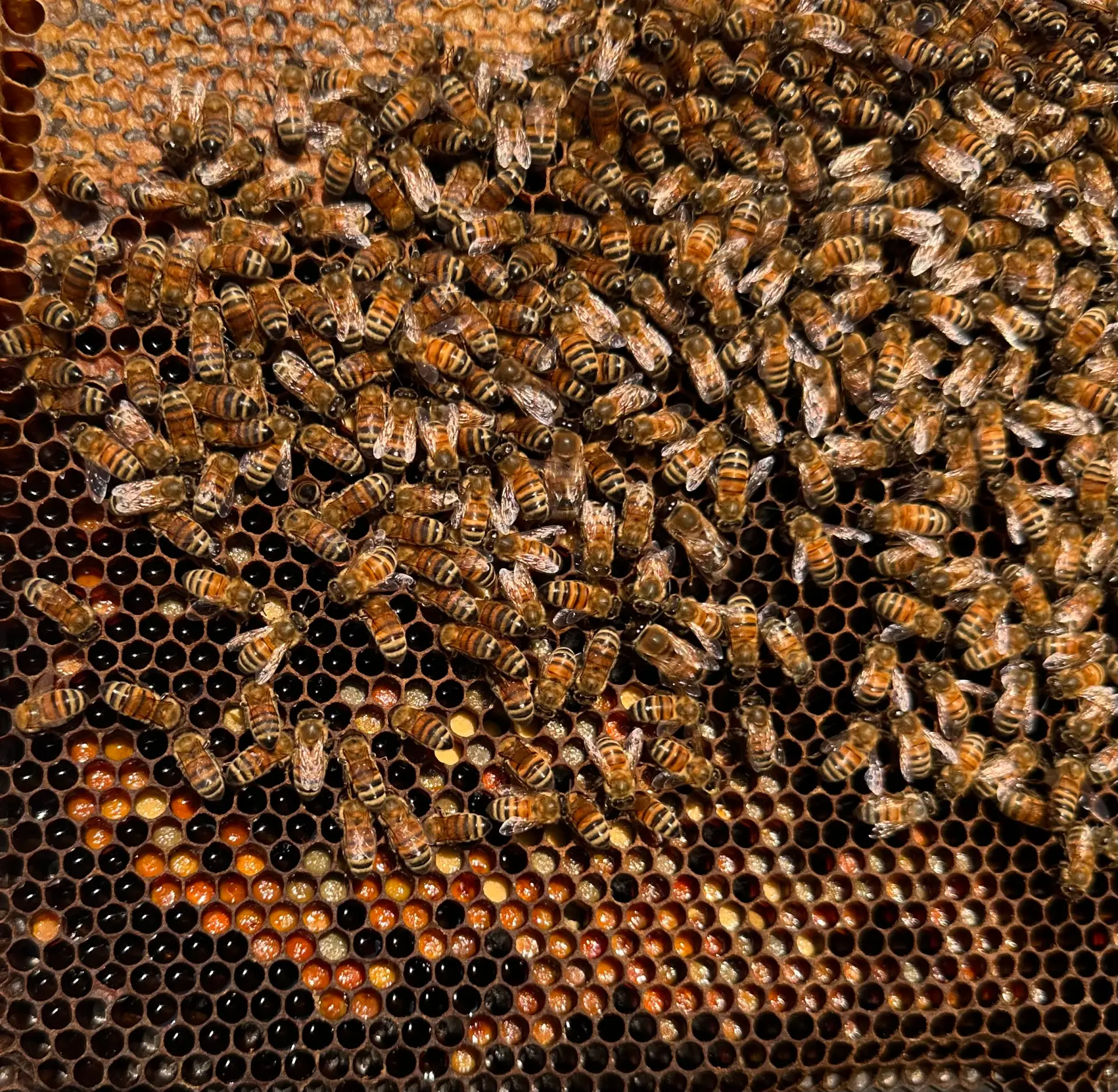
What Happens to Honey Before It Reaches the Grocery Shelf
Bees make honey at about 95°F inside the hive. Once extracted, raw honey is strained to remove wax and debris, then jarred. That’s the short version of the process when nothing else is added.
Commercial honey on the grocery shelf has usually gone through two additional steps: heating and ultrafiltration.
Heating serves a practical purpose for large-scale packing operations. It liquefies honey that has crystallized in storage, extends shelf life, and makes the product easier to pump through equipment at high speed. The temperatures used in commercial processing typically range from 149°F to 170°F. Some large-scale operations reach higher.
Ultrafiltration forces honey through extremely fine filters under high pressure. It removes pollen, wax particles, and other fine solids. The result is a product that is visually clear, uniformly golden, and shelf-stable for longer periods. It also resists crystallization, which retailers prefer because crystallized honey gets returned.
What does heat and ultrafiltration remove besides pollen and wax?
- Pollen: This is the one with traceability implications (more on that below), but pollen also carries minor nutritional compounds including flavonoids and phenolic acids.
- Enzymes: Honey naturally contains diastase, invertase, and glucose oxidase. These are produced by bees during nectar processing and are associated with honey’s antimicrobial properties. Heating above roughly 104°F begins to degrade them; significant loss occurs above 140°F.
- Antioxidants: Heat-sensitive phenolic compounds and flavonoids degrade with prolonged heat exposure.
- Volatile aromatics: The nuanced flavor compounds that vary by floral source are partly heat-volatile. Processed honey tends toward a generic sweetness.
None of this means commercial honey is inert or unhealthy. It’s still predominantly fructose and glucose, still sweeter than table sugar gram for gram, and still antimicrobial in concentrated form. The processing removes specific compounds, not all value. What gets lost is real, though.
The Pollen Problem and Country of Origin
Pollen removal has a secondary consequence that isn’t about nutrition at all.
Pollen is geographically specific. Each plant species produces morphologically distinct pollen grains, and because bees forage locally, the pollen in a jar of honey is a direct record of where that honey came from. Melissopalynology, the analysis of pollen in honey, is used to authenticate origin claims.
Honey without pollen cannot be traced to a source.
This matters because honey is one of the most adulterated food products in global trade. The FDA and USDA have documented repeated instances of honey being diluted with high-fructose corn syrup, rice syrup, and other sweeteners, then relabeled (FDA Releases Report on Economically Motivated Adulteration in Honey | FDA). It has also been imported from countries facing anti-dumping tariffs, transshipped through third countries, relabeled as a different origin, and sold at artificially low prices.
Removal of pollen through ultrafiltration makes this kind of adulteration significantly easier to conceal.
“Product of USA” labeling on honey does not require that all the honey was produced domestically. Under current FDA labeling rules, blended products list countries of origin, but enforcement is inconsistent and supply chain traceability is limited. Most large commercial brands blend honey from multiple international sources to maintain consistent supply, price stability, and flavor uniformity. This is disclosed on labels in small print.
What “Raw” Actually Means on a Label
There is no FDA standard of identity for “raw” honey. The word has no legal definition at the federal level.
In practice, “raw” on a honey label generally means:
- Not heated above a threshold the producer has set (often around 95°F to 105°F, intended to approximate hive temperature)
- Minimally filtered, usually through mesh or cloth to remove wax and debris but not pollen
- No additives
“Generally means” is doing real work in that sentence. Without a regulatory definition, producers set their own standards. A jar labeled “raw” from one operation and “raw” from another may have been processed quite differently.
What to look for alongside “raw”: small-scale production, identified source location, visible crystallization (a sign the honey hasn’t been heavily processed), and pollen content confirmed either by the producer or by third-party testing. Crystallization is worth understanding: it’s a natural process in raw honey driven by glucose content and temperature. It doesn’t indicate spoilage. Most raw honey will crystallize within weeks to months depending on floral source. Clover crystallizes quickly. Tupelo and black locust resist it.
What Raw Looks Like in Practice
At Bloom & Buzz, we extract honey, strain it through mesh to remove wax and large particles, and jar it. No heating beyond what’s present in the extraction environment. No ultrafiltration. No additives.
The honey we produce comes from hives on our 50-acre property in Yuma, Tennessee and the surrounding area. Our bees are working primarily canola in early spring, with clover, tulip poplar, and native wildflowers through the season. The floral source shows up in the honey: our spring honey crystallizes fairly quickly because canola honey is high in glucose. That’s normal, and the crystals dissolve easily if you set the jar in warm water.
The pollen stays in. The enzymes stay in. The flavor varies by season because the forage varies by season.
We sell raw liquid honey, creamed honey (controlled crystallization to a smooth, spreadable texture), and Hogg Halfcomb comb honey: honey still in the wax cells, exactly as the bees built it. The comb product is as unprocessed as honey gets.
Raw Honey vs Store Honey: Side by Side
| Raw/Artisan | Commercial Processed | |
|---|---|---|
| Heat treatment | Minimal or none | Yes, often 149°F+ |
| Filtration | Coarse (wax/debris only) | Ultrafiltration (removes pollen) |
| Pollen present | Yes | Typically no |
| Enzymes intact | Yes | Degraded |
| Crystallization | Normal, expected | Inhibited |
| Origin traceability | Traceable | Difficult to verify |
| Additives | None | Varies; check label |
The raw option costs more. The reasons above are why.
If you want honey that’s been minimally handled, comes from a traceable source, and retains what the bees built into it, the label to look for is “raw” from a producer who can tell you where the hives are. If you want a consistent, inexpensive sweetener with a long shelf life, commercial honey does that job.
Both options exist for a reason. These are the facts behind the choice.