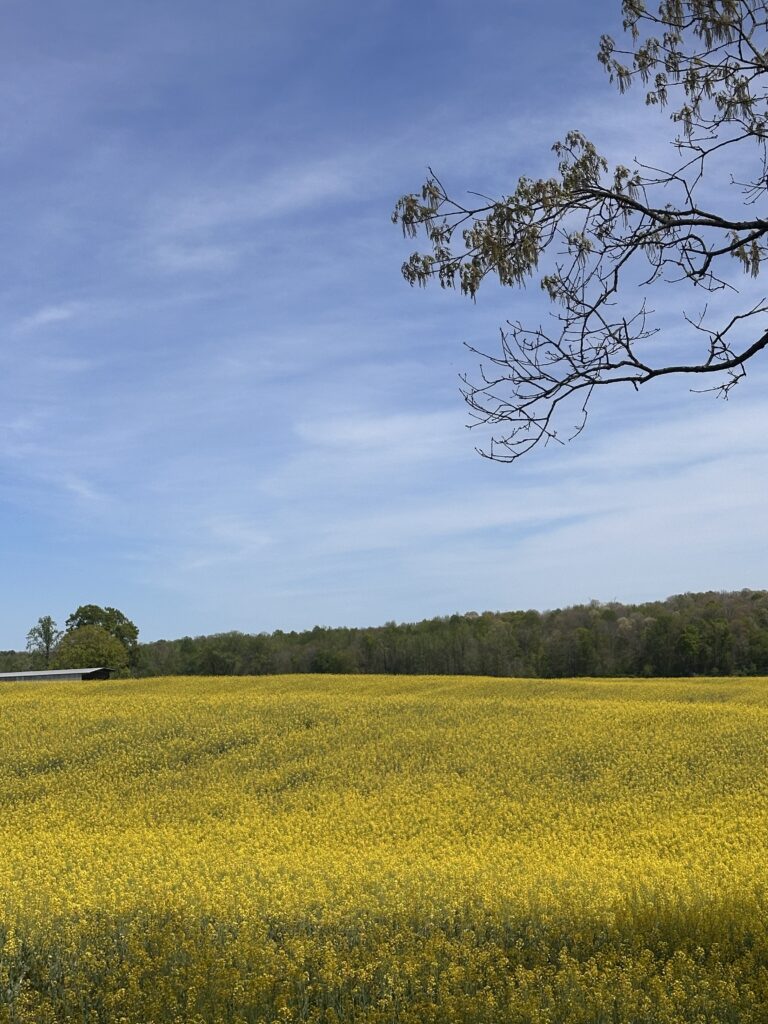
Carroll County spring honey starts in a yellow field. The canola surrounding our apiary on Enoch Cemetery Road is at peak bloom right now, row-crop yellow in every direction the bees leave from. This is the window that defines what ends up in the jar each spring, and it closes fast.
What canola means for the hives
Canola (Brassica napus) is a high-yield nectar and pollen source that blooms early, before most summer foragers are active. The plant produces abundant nectar with a moderately high sugar concentration, and it blooms densely enough that foragers can work it efficiently, which matters to a colony still building spring population.
Penn State Extension notes that canola flowers have open petals that make pollen and nectar available to all sizes of bees, and high pollinator diversity has been observed on spring-blooming canola.
The fields surrounding this apiary are part of a large-acreage agricultural program supplying biofuel crush facilities in the region. That means the canola here isn’t incidental. It’s intentional, contracted, and planted at scale. For the bees, it means a predictable, concentrated forage source within their primary foraging range.
Bloom & Buzz apiary with neighboring canola fields in bloom, Carroll County spring honey season
During peak bloom, hive behavior shifts noticeably. Incoming traffic increases. Nectar loads go in faster than the colony can process them. Brood nest space compresses as bees start backfilling comb with nectar and fresh pollen. Left unmanaged, a colony can become honey-bound, where nectar storage crowds out laying space and triggers swarm impulse. Active management through bloom, adding drawn comb, running timely splits, and monitoring for queen cells, is what keeps spring momentum building rather than stalling.
What Carroll County Spring Honey Tastes Like and Why
Canola honey is light-colored, mild, and fast to granulate. The granulation rate is a chemical property of the nectar: canola honey has a high glucose-to-fructose ratio, which drives rapid crystal formation. Extracted frames need to move quickly. Comb honey produced during the canola bloom granulates in the cell if left too long, which is why harvest timing during this window is not optional.
The National Honey Board confirms that crystallization is a natural process driven by glucose precipitating out of solution, and that different varieties crystallize at different rates. Canola sits at the fast end of that range.
The flavor is clean and lightly sweet, with none of the assertiveness you get from fall honey. If you’ve tasted Carroll County spring honey and found it mild compared to what you expected, that’s partly the canola talking, and partly the difference between spring forage and the late-season goldenrod and aster that define fall harvest flavor.
The spring honey coming off these hives reflects what’s in the ground around them. Intentionally planted, regionally specific, and available for a few weeks each year.
Why does this make Carroll County honey distinct right now
Most commercial honey is blended across sources, seasons, and regions to produce a consistent product year over year. What we do is the opposite: single-source, single-season, from hives that forage within a defined area. The canola bloom visible from the apiary is the same bloom that the bees are working. That’s not a marketing claim. It’s geography.
Spring honey from this apiary is available in limited quantity. When the bloom ends, this run closes.
The Tennessee Honey Guide
If you want to understand what goes into raw Tennessee honey, including how forage, season, and production method affect what ends up in the jar, the Tennessee Honey Guide covers it. Free download below.