Skip to content
Bloom & Buzz Small-batch. Single source. Carroll County, Tennessee.

Field grown in Carroll County, Tennessee

Willow with a life beyond the field.

Field-grown willow rods, cuttings, plants, catkin stems, and living-willow kits from our West Tennessee farmstead.

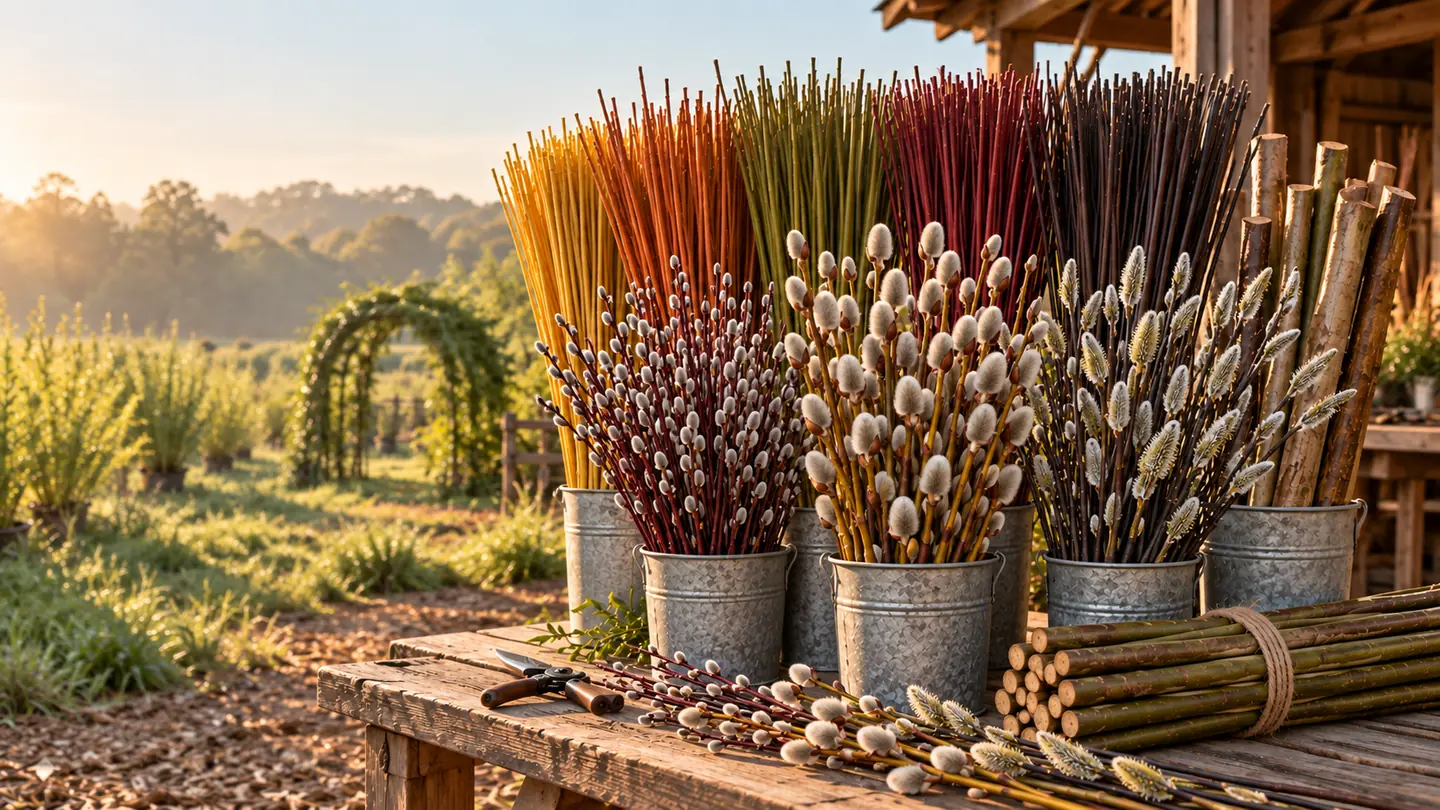
Finished willow products with colorful rods and varied catkin stems

Start here

What are you trying to do?

Your goal

Grow or plant willow

Willow Works › Grow or plant willow › Choose a topic

Choose what to plant

Start with the job, not the cultivar name.

Define the outcome first

A willow for catkins, winter stem color, structural rods, a living tunnel, habitat, or a future pollard may need a different growth habit and management system. Decide what success looks like before comparing varieties.

Compare the traits that affect that job

Look at vigor, mature size, stem length and straightness, flexibility or rigidity, flower display, bark color, rooting ability, and site tolerance. A visually striking variety is not automatically the best structural or planting material.

Expect management to shape the material

Variety matters, but cutting interval, training form, soil moisture, and establishment also change what the plant produces. The catalog is a starting point for matching genetics and use, not a guarantee that every stem will be identical.
Planting & establishment

Get the plant established before asking it to produce.

Cuttings and rooted plants are different starting formats

Dormant unrooted material can establish efficiently when planted at the right time and kept from drying out. Rooted plants begin with an established root system and may suit sites or schedules where a larger starting plant is useful.

Match the site to the future management system

Consider light, reliable moisture during establishment, drainage, mature managed size, access for future cutting, and conflicts with structures or paths. Spacing should follow the intended form rather than a single generic willow rule.

The first season is about roots and sustained growth

Keep new plants from drying out, manage strong weed competition, protect them where browsing pressure is significant, and avoid treating a newly established plant as if it were already a production stool or mature pollard.

Choose the training form early

A stool, pollard, living structure, shrub, or single-trunk specimen develops differently. Early training should move the plant toward the form you actually intend to maintain.

Need planting material? Check planting material availability

Establish a pollard

Build the future head deliberately.

Pollarding begins before there is a pollard head

Establish a healthy young tree and decide the future recurring cutting height. The goal is to create a managed framework that can respond to repeated cutting, not to imitate the appearance of an old pollard immediately.

Early regrowth builds the long-term architecture

After formative cuts, vigorous shoots develop around the managed head. Repeated cycles gradually enlarge the knuckle and create the recognizable architecture seen on mature pollards.

Species, age, condition, and timing matter

Pollarding is not appropriate for every tree or every starting condition. A young tree being intentionally trained is a different situation from an old unpollarded tree that someone wants to cut severely.

See the complete lifecycle

Ecology & habitat

Willow can do more than produce material.

Early forage

Flowering willow can provide valuable early-season pollen and nectar resources when relatively few other woody plants are active. Flowering time and sex expression vary by species and selection.

Wet-site and stabilization roles

Some willows are useful where moisture tolerance, rapid rooting, or dense fibrous growth helps stabilize soil or establish woody cover. Site fit still matters; “willow” is not one uniform ecological prescription.

Managed trees can gain habitat value with age

Mature and veteran pollards may develop cavities, hollowing, deadwood, and complex structure that support habitat while the living crown continues to regrow. Ecological value and production goals can coexist when management acknowledges both.

Your goal

Build or make with willow

Willow Works › Build or make with willow › Choose a topic

Start a living structure

Treat it as both a structure and a planting.

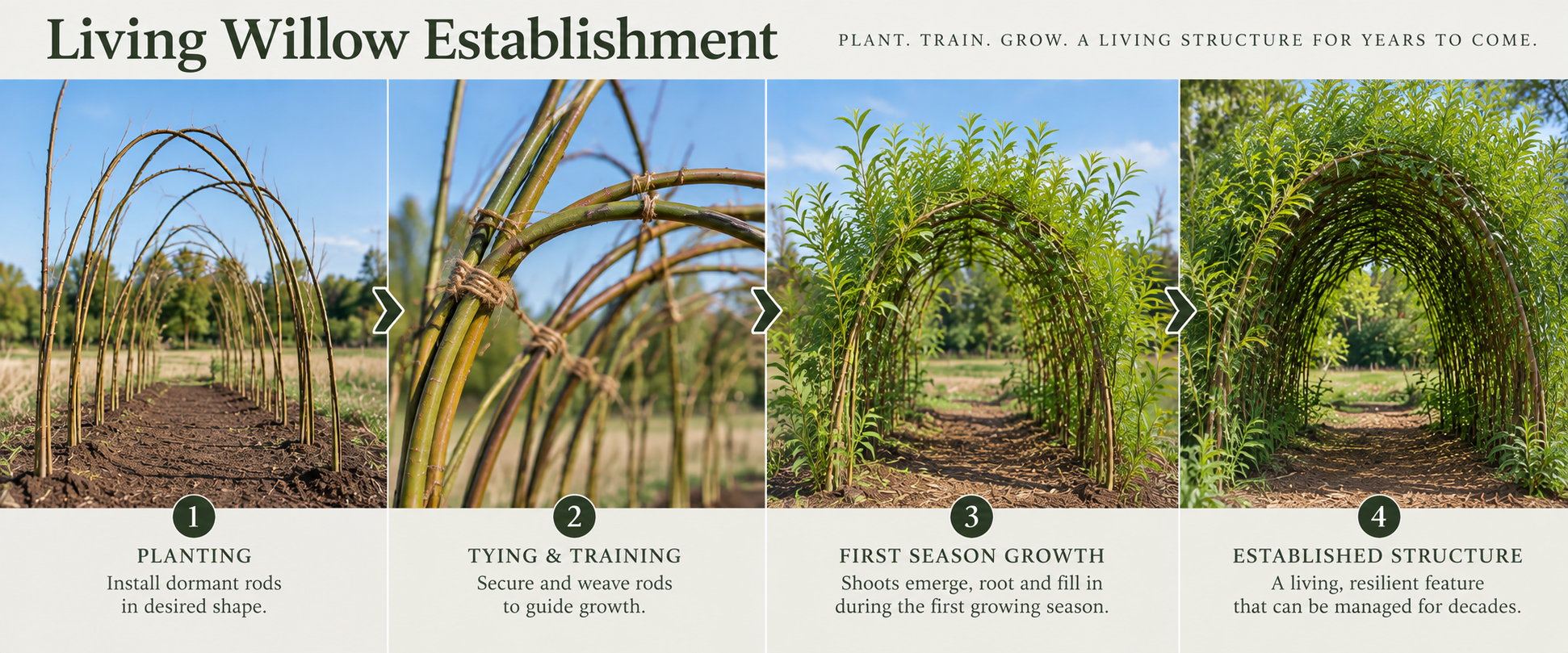
Four-stage visual sequence showing living willow from dormant rod planting through training, first-season growth, and an established living structure

Design the geometry before ordering rods

Tunnel, dome, arch, fence, screen, and room geometries create different rod counts and structural roles. Set the finished dimensions, planting depth, crossings, and access before sizing the material.

Use viable material that can establish

Living structures depend on rooting and continued growth. Rod dimensions matter, but viability, planting orientation, moisture, and the condition of the material are equally important.

Installation begins the maintenance cycle

New rods need reliable moisture, secure but non-damaging ties, early replacement of failures, and training of new shoots. Future pruning and weaving should be part of the design from the beginning.

Size a projectPlan a sculpture kit

Maintain a living structure

Keep the plants healthy while repeatedly directing growth back into the design.

  1. EstablishmentKeep the planting supported and watered; replace failed rods early and check ties while rooting and new shoot growth develop.
  2. Formative trainingSelect useful new shoots, weave or redirect growth where the design needs it, and remove growth that immediately conflicts with openings or access.
  3. Routine pruningMaintain height, width, openings, and the intended pattern with recurring pruning rather than allowing several years of uncontrolled growth to accumulate.
  4. Mature structureAs stems thicken and crossings become permanent, inspect for constricting ties, crowding, weak sections, and growth that changes the original geometry.
  5. Repair and rejuvenationUse vigorous replacement shoots or new planting material to close gaps, redirect growth into thin areas, and rebuild local failures without unnecessarily dismantling healthy sections.
Replacement material only when neededCheck replacement material availability

Choose rods for making

Specify the material by how it needs to behave.

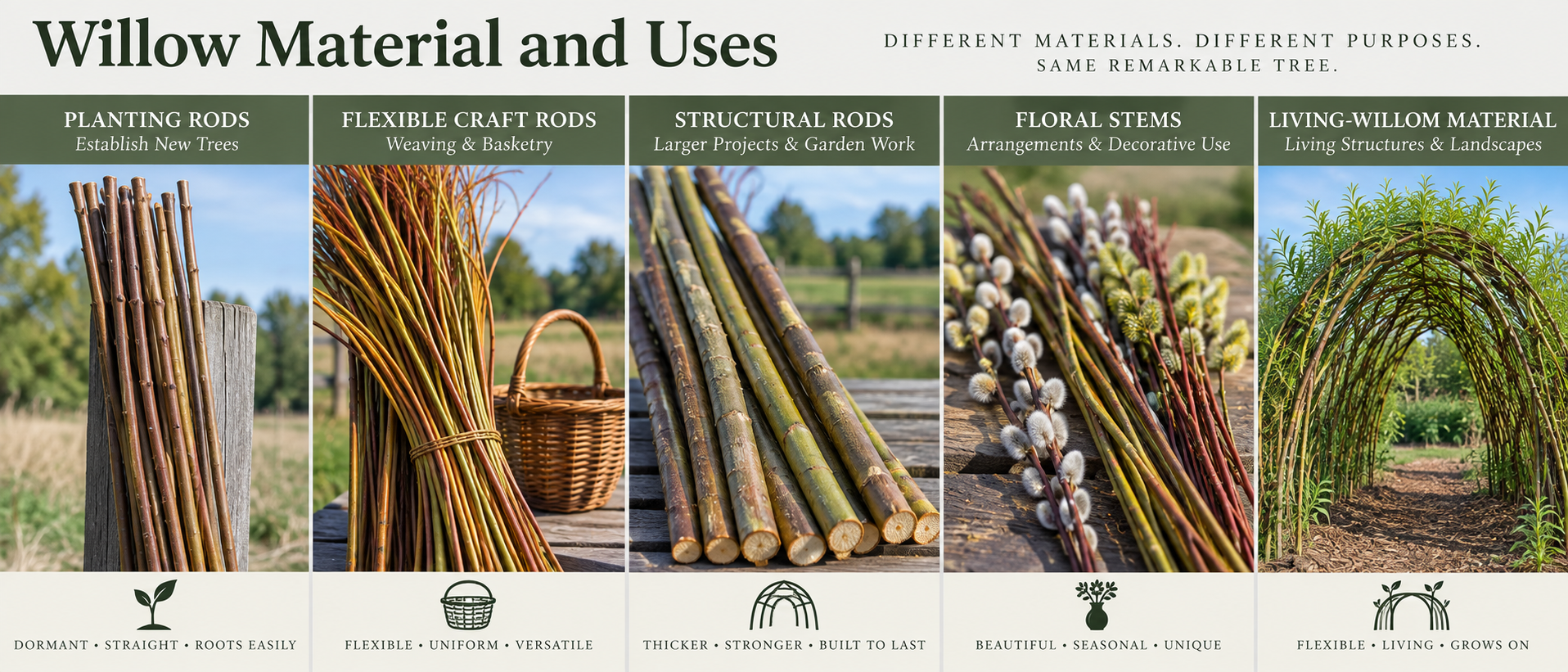
Comparison of willow planting rods, flexible craft rods, structural rods, floral stems, and living-willow material

Length is only one specification

Basal diameter, taper, straightness, branching, flexibility, rigidity, age, and uniformity determine whether a rod fits detailed weaving, a structural frame, or another use.

Fine and heavy rods solve different problems

Fine rods bend easily and suit detail; heavier rods provide stiffness and span. Many projects use more than one grade because the frame and the infill have different jobs.

Harvest and storage change working properties

Fresh, dormant, dried, and reconditioned rods do not behave identically. Plan the harvest or purchase window around whether you need rooting, maximum flexibility, dry craft material, or a particular appearance.

Plan a larger project

Move to project-scale planning when retail bundles stop making sense.

Define the design and material specification

Large living structures, repeated installations, schools, landscape work, and production-scale rod needs require quantities, lengths, grades, timing, and acceptable substitutions to be defined together.

Plan around field availability

Willow is seasonal agricultural material. Larger orders benefit from advance communication so the target harvest window, grading, packing, and fulfillment method can be aligned with the project schedule.

Project-scale sourcingWholesale & Design

Your goal

Floral & decorative stems

Willow Works › Floral & decorative stems › Choose a material

Catkin stems

Specify the stage as carefully as the stem.

Catkin stage changes the visual effect

Tight, expanding, and open catkins can look substantially different. Event timing should specify the desired stage while allowing for weather-driven variation in the field.

Branch architecture still matters

Usable length, straightness, side branching, catkin density, and stem diameter determine how the branch works in a vase or installation, not simply whether it has catkins.

Condition and hold the material for the intended use

Fresh woody stems should be protected from drying and heat and handled according to the crop and display method. Test unfamiliar material before relying on it for a critical event.

How much material do you need?

Standard order
Use currently listed seasonal bundles when the material and quantity already match the design.

Check seasonal shop availability →

Event, studio, resale, or recurring quantity
Plan larger stem counts around the event date, grades, visual objective, substitutions, packing, and fulfillment.

Plan a wholesale floral order →

Color stems

Choose dormant stems by color, line, and usable length.

Color is strongest only in the right season and growth

Dormant bark color changes with cultivar, stem age, light, and season. Product descriptions should be read as a seasonal visual range rather than a manufactured color specification.

Decide whether you need line or branching

Straight rods create clean vertical and linear movement; branched stems create volume and complexity. Usable length and diameter should be specified alongside color.

Plan acceptable substitutions

For event work, define the visual objective—such as bright red, yellow-green, or multitone—so a suitable seasonal substitution can be considered if a specific cultivar is unavailable.

How much material do you need?

Standard order
Use currently listed seasonal bundles when the material and quantity already match the design.

Check seasonal shop availability →

Event, studio, resale, or recurring quantity
Plan larger stem counts around the event date, grades, visual objective, substitutions, packing, and fulfillment.

Plan a wholesale floral order →

Architectural stems

Use form and movement as the primary specification.

Sculptural material is intentionally less uniform

Contorted, fan-shaped, heavily branched, or otherwise distinctive stems are selected for character. Exact replication is less important than the overall scale, movement, and design role.

Match the branch to the installation

Large focal work may need heavier diameter and wider branching; tabletop or detailed work may need smaller scale. Decide how the stem will be supported before choosing the grade.

Fresh and dried uses can differ

Some architectural material remains useful after drying while other crops are most valuable fresh. Confirm the intended state and handling window when ordering.

How much material do you need?

Standard order
Use currently listed seasonal bundles when the material and quantity already match the design.

Check seasonal shop availability →

Event, studio, resale, or recurring quantity
Plan larger stem counts around the event date, grades, visual objective, substitutions, packing, and fulfillment.

Plan a wholesale floral order →

Foliage, berries & texture

Build a broader field-grown palette around the willow.

Choose the role before the crop

Foliage and filler soften or connect a design; berries and seed heads provide texture and seasonal emphasis; flowers provide color; specialty branches create focal form. Start with the design role, then compare crops.

Maturity and harvest window matter

Berry color, seed-head firmness, foliage quality, bloom stage, and stem strength change through the season. The useful harvest window can be shorter than the plant’s overall growing season.

Companion stems are agricultural material too

Availability should be expected to follow field performance and season rather than a year-round wholesale catalog. Advance orders work best when the customer can define acceptable visual substitutions.

How much material do you need?

Standard order
Use currently listed seasonal bundles when the material and quantity already match the design.

Check seasonal shop availability →

Event, studio, resale, or recurring quantity
Plan larger stem counts around the event date, grades, visual objective, substitutions, packing, and fulfillment.

Plan a wholesale floral order →

Your goal

Manage a pollarded or established tree

Willow Works › Manage an established tree › Choose a topic

Pollarding as a management system

Understand the lifecycle before making a cut.

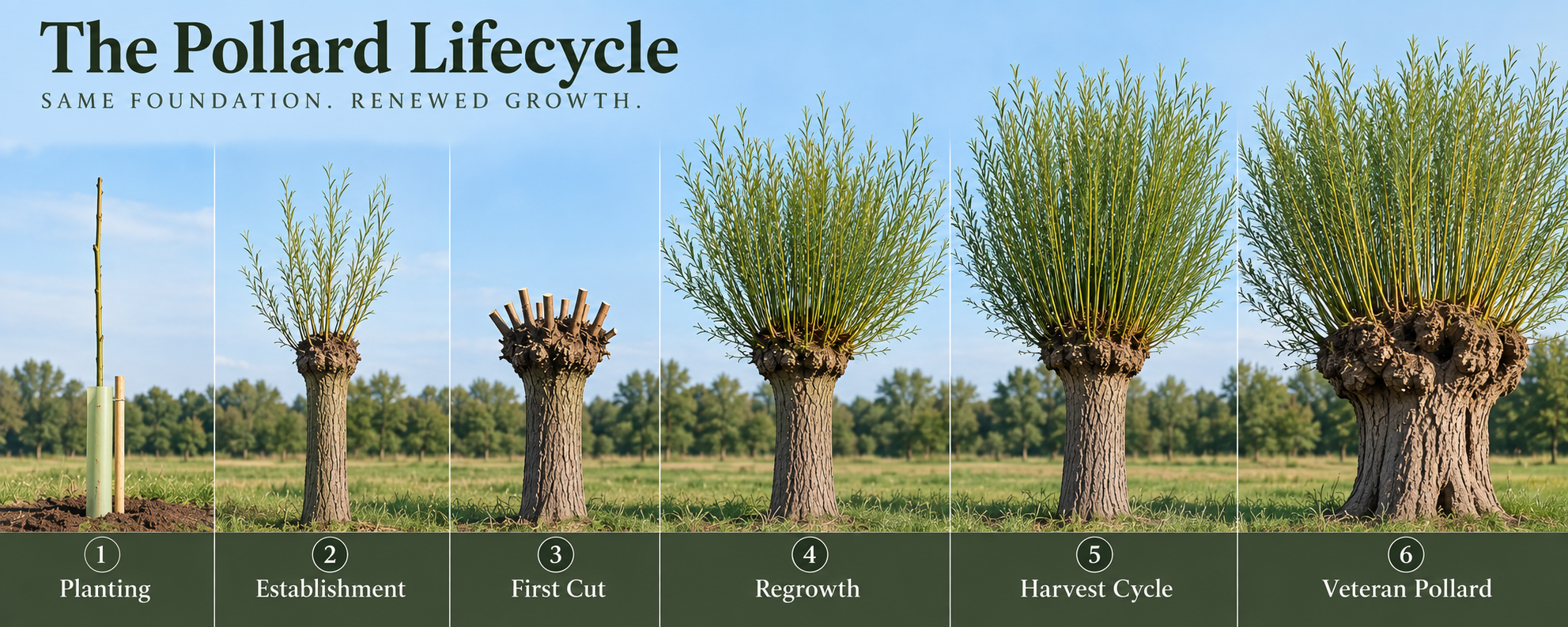
Pollarding is a repeated system, not a one-time severe pruning event. Developmental age and cutting-cycle stage are separate ideas.

Six-stage visual overview of willow pollarding from planting through establishment, first cut, regrowth, harvest cycle, and veteran pollard
1

Stage 1

Establishing a pollard

The first goal is to establish a healthy tree and create the future pollard head at a deliberate height. Early cuts begin the repeated management pattern rather than producing a finished mature head immediately.

2

Stage 2

Developing pollard

A young pollard builds its head through repeated regrowth and cutting. Shoot distribution, vigor, and the developing knuckle structure start to define the long-term form.

3

Stage 3

Established production pollard

Once established, the tree moves through a repeatable cycle: cut, regrow, develop rods, and return to harvest or maintenance at the chosen interval.

4

Stage 4

Mature pollard

Years of repeated cutting enlarge the head and create a recognizable architecture of knuckles, old cut surfaces, retained stubs, and recurring rod growth.

5

Stage 5

Veteran pollard

Very old pollards can combine living regrowth with cavities, hollowing, deadwood, habitat features, and structural adaptation. Management increasingly balances continued cutting with the aging tree.

Restoration after neglect is not routine maintenance

An overgrown or irregularly managed pollard may carry large accumulated stems, decay, cavities, weak attachments, or uncertain structural history. Do not assume it should be returned to an old cutting point in one drastic step.

Studying willow pollards in depth? The public Willow Pollard Study Archive contains the Willow (Salix) specimens from the Netherlands study. Confirmed non-willow observations remain preserved as internal research references. Explore the Willow Study Archive →

Condition & management problems

Describe what is visible before trying to diagnose it.

Cavities, old wounds, dieback, decay, vigorous regrowth, and hollowing can coexist on an old pollard. A photograph can document visible features but often cannot establish cause, severity, or structural safety.

Cavities and hollowing

Shows a visible cavity or hollowing feature without treating the photograph as a complete diagnosis.

Historic cuts and wound surfaces

Shows old cuts, scars, or retained stubs that help explain how repeated pollarding changes the head.

Dieback or decline

Shows visible decline features that can be described and monitored before assigning a cause.

Neglect, irregular cutting, and restoration

Shows a tree whose management history may require a restoration approach rather than simply returning to a routine cutting cycle.

Know when this is no longer a web-learning problem

Large limbs, work at height, significant decay, uncertain structural stability, targets such as people or buildings, or restoration of an old veteran tree can require an on-site assessment by a qualified arborist. Online examples are educational evidence, not clearance for hazardous work.